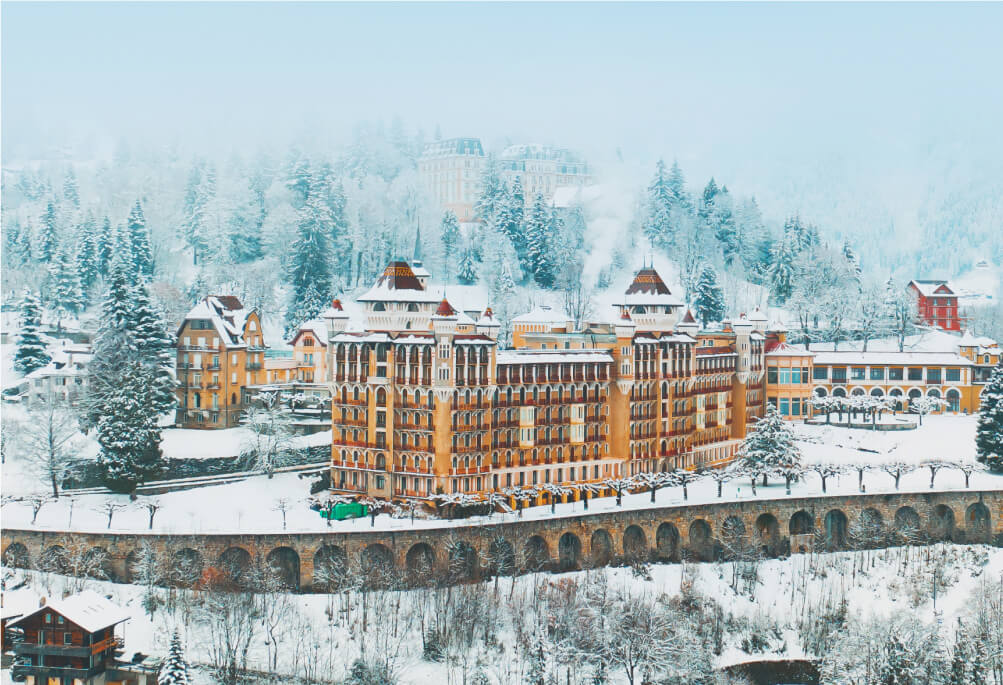
Swiss Hotel Management School (SHMS) offers a hospitality education closely connected to Switzerland’s identity. Students do not only study management in a conventional classroom; they live and learn in a former palace hotel in Caux and in the Alpine resort setting of Leysin.
For Indonesian students interested in international careers across hotels, tourism, events, or luxury business, SHMS can be an attractive study option. Its approach brings together Swiss hospitality traditions, practical learning, technology, business, and industry experience.
Introducing Swiss Hotel Management School
SHMS is a hospitality school in Switzerland built around a learning by doing philosophy. According to the official SHMS website, students develop their abilities through real activities such as managing campus restaurants or spa facilities, organising events for guests, and creating design concepts relevant to the industry.
SHMS operates two main campuses. The Caux campus occupies a former palace hotel overlooking the Lake Geneva region, while the Leysin campus is located in an Alpine resort environment. These settings make the campus more than a place to attend classes: it becomes a hospitality laboratory where students experience guest service firsthand.
SHMS states that it ranks among the world’s top four institutions for Hospitality and Leisure Management in the 2026 QS World University Rankings. The school also has an international student community and a global alumni network, helping students develop valuable cross-cultural perspectives.
Study Options at SHMS
Through its official programme pages, SHMS offers study routes for different academic backgrounds and career objectives, including:
- Swiss Professional Degree in Hospitality Management, combining academic learning, practical training, and internship experience.
- Bachelor of Arts in International Hospitality Management, a three-year programme developing operational, business, and leadership foundations.
- Postgraduate Diploma in International Hotel, Resort, and Spa Management, an intensive pathway for graduates entering or advancing within hospitality.
- Postgraduate and master’s programmes focused on international hospitality management, strategy, innovation, and leadership.
Programme structures, awards, duration, intakes, and admission requirements may change. Applicants should therefore confirm the latest details before applying.
Learning through Practice and Internships
A major advantage of hospitality education is the close relationship between theory and practice. Selected SHMS programmes include paid internships in their curricula. Students can apply their service, operations, cross-cultural communication, team management, and problem-solving skills in a real workplace.
This experience matters because hospitality employers assess more than academic knowledge. They need candidates who can engage with guests, adapt to service standards, collaborate in multinational teams, and remain professional in fast-moving situations.
Career Prospects for SHMS Graduates
Hospitality skills can lead to roles across a wide range of functions and industries. Beyond hotels and resorts, graduates may explore event management, luxury brand management, food and beverage, guest experience, sales and marketing, revenue management, consulting, wellness, and entrepreneurship.
SHMS reports that 90% of its graduates receive more than one job offer before graduation, 89% hold management positions or create their own businesses, and 71% work in hospitality, tourism, and culinary sectors. These are school-reported alumni outcomes and should be viewed as an indication of graduate results, not a guarantee of employment for every student.
Can Indonesian Graduates Work in Switzerland?
Opportunities exist, but employment is not automatic. Indonesian citizens are treated as third-country nationals because Indonesia is not an EU/EFTA member state. According to the official Swiss government portal, non‑EU/EFTA nationals require a work permit even for short-term employment. Permits are limited and admission generally focuses on highly qualified candidates.
After making a job offer, a Swiss employer will normally need to submit a permit application to the relevant cantonal authority. The position, the applicant’s qualifications, salary and employment conditions, the role’s academic or economic importance, and labour-market rules may all be assessed. A job offer alone therefore does not guarantee approval.
What about the Six-Month Job-Search Period?
The State Secretariat for Migration (SEM) explains that third-country nationals graduating from a recognised Swiss higher education institution may receive up to six months after completing their studies to seek work matching their qualifications. Eligibility, however, is connected to the status of the institution and the qualification completed.
The official list of accredited higher education institutions is maintained by swissuniversities. SHMS itself was not listed as a standalone institution when this article was prepared. At the same time, SHMS offers different qualifications, including a Swiss professional qualification and degrees validated or awarded with an overseas partner. Students should therefore not assume that every SHMS programme automatically provides eligibility for the six-month graduate job-search permit.
Before choosing a programme with the goal of working in Switzerland after graduation, request written confirmation from SHMS and the relevant cantonal migration authority about:
- The type of award and the degree-awarding institution;
- The programme’s recognition for residence-permit purposes;
- Eligibility for a post-graduation job-search permit;
- Required evidence of funds, accommodation, and other documents;
- The employer-sponsored work-permit process.
Immigration rules can change and their application may involve cantonal authorities. This information is general guidance, not legal advice or a guarantee that a permit will be issued.
How to Strengthen Your Career Prospects
Indonesian students can prepare early by building strong internship experience, learning French or German for their preferred region, developing an industry network, and creating a portfolio that demonstrates measurable results. Understanding employer needs and targeting positions connected to the completed qualification will also be more effective than waiting until graduation approaches.
Career opportunities are not limited to Switzerland. An international hospitality education can also support applications to global hotel groups, luxury companies, tourism and event businesses in other countries, or leadership roles back in Indonesia.
Prepare for SHMS with RIM Education
Choosing a programme in Switzerland requires careful consideration—from academic fit, English-language requirements, and costs to internships and post-graduation career plans.
RIM Education can help you understand SHMS programme options and prepare your study journey around your profile and career objectives. Contact RIM Education to discuss your plans for studying hospitality in Switzerland.