SAT Math Question Types: The 4 Areas You Need to Know
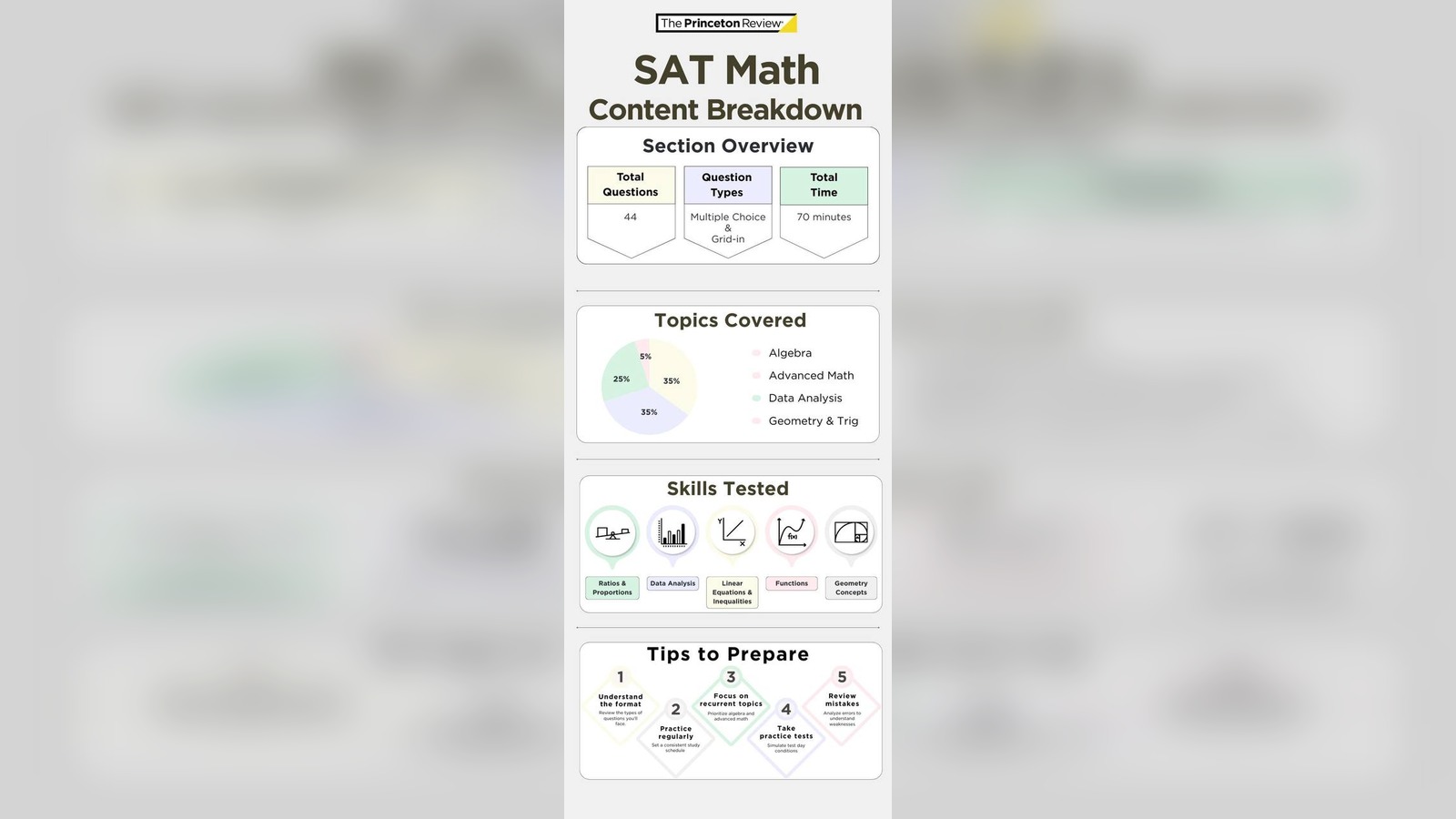
Short answer: the SAT Math section covers four areas: Algebra, Advanced Math, Problem-Solving and Data Analysis, and Geometry and Trigonometry.[1] Effective preparation is therefore not just about completing a large number of random questions; you need to know which areas are already strong and which still need attention.
Here is a clearer way to read the four areas.
1. Algebra: building a foundation in linear equations
College Board says Algebra measures the ability to analyse, solve and create linear equations and inequalities, including systems of equations using multiple techniques.[2]
Topics to recognise include:
- linear functions;
- systems of two linear equations in two variables; and
- linear inequalities in one or two variables.[2]
Practice approach: do not only chase the final answer. Build the habit of writing what is known, defining a variable, and checking whether an answer makes sense when substituted back into the equation.
2. Advanced Math: working with functions and nonlinear expressions
Advanced Math focuses on skills central to progression into more advanced mathematics, including absolute value and quadratic, exponential, polynomial, rational, radical and other nonlinear equations.[3]
College Board also lists equivalent expressions, one-variable nonlinear equations, two-variable systems of equations and nonlinear functions within this area.[3]
Practice approach: group practice by form. You might devote one session to quadratics and factoring, then another to exponential or rational expressions. That makes it easier to identify whether mistakes come from the concept, algebraic manipulation or the way a question was read.
3. Problem-Solving and Data Analysis: reading numbers in context
This area measures quantitative reasoning about ratios, rates, proportional relationships and unit rate, along with analysing and interpreting one- and two-variable data.[4]
Its listed topics include:
- percentages;
- data distributions and measures of centre and spread;
- models and scatterplots for two-variable data;
- probability and conditional probability; and
- inference from sample statistics and margin of error.[4]
Practice approach: before calculating, ask “What does this number represent?” Many mistakes occur not because a formula is difficult, but because a student has misread a unit, percentage, population or relationship in a graph.
4. Geometry and Trigonometry: shape, measurement and spatial relationships
College Board lists area and volume formulas, lines–angles–triangles, right triangles and trigonometry, and circles within Geometry and Trigonometry.[5]
Practice approach: create a formula summary that you understand rather than simply memorise. When practising, redraw diagrams with your own labels and record units for length, area or volume. For trigonometry, understand side relationships in a right triangle before relying on memory.
How should you organise an SAT Math study plan?
Start with a simple diagnosis:
- Complete a small set of official or SAT-format practice questions.
- Label each error using one of the four areas above.
- Separate concept errors, calculation errors, reading errors and time-management errors.
- Choose one priority area for each practice session.
- Reattempt missed questions several days later without looking at the explanation.
This approach helps you build understanding rather than only memorising answer patterns.
FAQ: Do I need to master every topic before I begin practising?
No. You do not need to be perfect before you start. Targeted practice is how you discover which foundations need work. If Algebra is weak, begin with linear equations and functions. If data analysis feels confusing, practise turning tables and graphs into simple sentences before calculating.
Next step
Preparing for the SAT as part of an overseas university application? Contact RIM Education to discuss application planning, university choices and documents to prepare.
Note: always check College Board’s official pages for the current SAT structure and content before taking the test.
Sources
[1] https://satsuite.collegeboard.org/sat/whats-on-the-test/math/types — Types of Math Tested – SAT Suite
[2] https://satsuite.collegeboard.org/sat/whats-on-the-test/math/types/algebra — Algebra – SAT Suite
[3] https://satsuite.collegeboard.org/sat/whats-on-the-test/math/types/advanced — Advanced Math – SAT Suite
[4] https://satsuite.collegeboard.org/sat/whats-on-the-test/math/types/problem-solving — Problem-Solving and Data Analysis – SAT Suite
[5] https://satsuite.collegeboard.org/sat/whats-on-the-test/math/types/geometry-trigonometry — Geometry and Trigonometry – SAT Suite